

Culbone Standing Stone
FiPL works best when it is a collaborative effort, and projects often come to us via ENPA colleagues, who in their own work, are able to link the FiPL team to new potential applicants. This is certainly true of this small scape FiPL project that has been of interest to multiple departments within ENPA.
The wide expanse of Exmoor is an historic landscape showing evidence of habitation by humans for thousands of years with the earliest finds from the Mesolithic period (8000-4000 BC). The first settled communities built a range of monuments and Exmoor is especially rich in prehistoric standing stones as well as nearly 400 burial mounds. Some of the most famous standing stones are the inscribed Caractacus Stone on Winsford hill and the Culbone Stone Row. At Culbone, there is a line of standing stones, running from east to west, looking out to sea and pointing towards a barrow at either end, and likely constructed in the Bronze Age.
During Storm Darragh in late 2024, strong winds buffeted the North Exmoor coast, leading to a number of trees falling. Amongst those was a Scots Pine, which as it fell, pulled up its own rootplate, and with it, one of the more easterly standing stones in the Culbone stone row, thought to be 4000 years old.
Total Grant Request £1,892.40
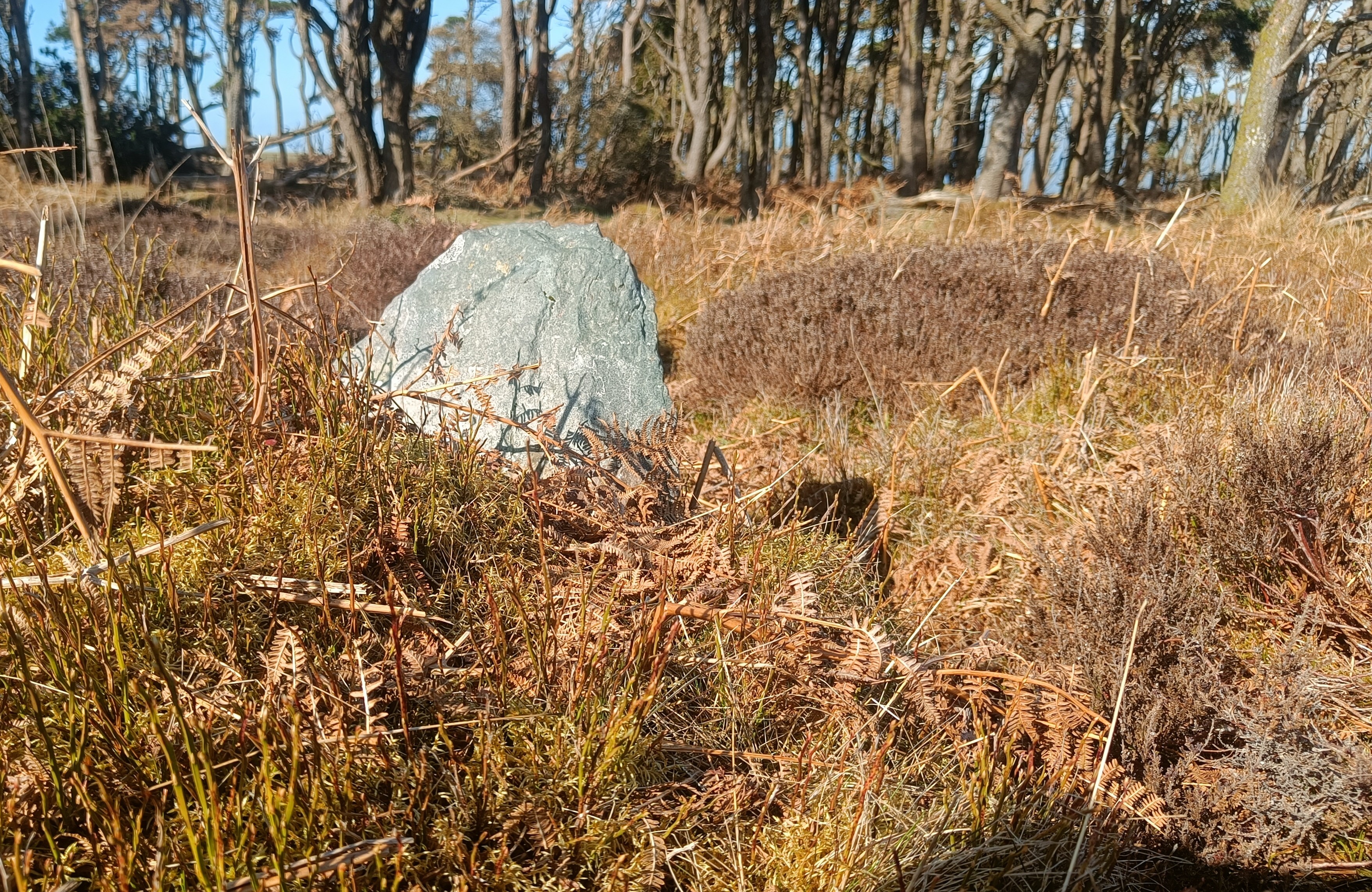
The landowner happened to be in touch with the ENPA Exmoor Invasive Non Native Species (ENNIS) Project Officer, who suggested he make contact with the FiPL team to see if they could support some work in the Scots Pine plantation after the storm. After a couple of phone calls the FiPL Officer went to site, with the Woodlands Officer and Historic Environment Officer.
The site, a mix of heather moorland, surrounded by Scots Pines, overlooking the sea, dotted with historic monuments is a unique Exmoor landscape. The team were all excited to see the stone, lifted out of the ground, with exposed soil and geology that was 4000 years old. A plan was put together to reinstate the stone, as well as gather some information on the stones, the underlying geology and the tree. The plantation of Scots Pines at Culbone were planted by Ada Lovelace and William King around 1850 and at one point were much more expansive over the top of the hills, but have more recently been replaced with conifer woodland. The opportunity to add to the knowledge of Ada and William, alongside the standing stone itself, was a good fit to the FiPL themes of People and Place, as well as touching on the issue of a changing climate. The Historic Environment and Woodlands Officers were able to write a brief for the applicant to use, and with the support of the FiPL team, an application was put together for funding to support the work. The application was duly approved and the work to re-instate the tree and its stone was completed in summer of 2025.
The local archaeology team instructed to complete the work were on site with a local groundworks contractor, and between them, the tree was cut and the rootplate and small section of trunk reinstated, with the standing stone being repositioned in its intended place. The tree was dated by its rings as 103 years old, so we can say it was not intentionally planted by Ada Lovelace over the stone but is most likely natural regeneration from one of the original pines.