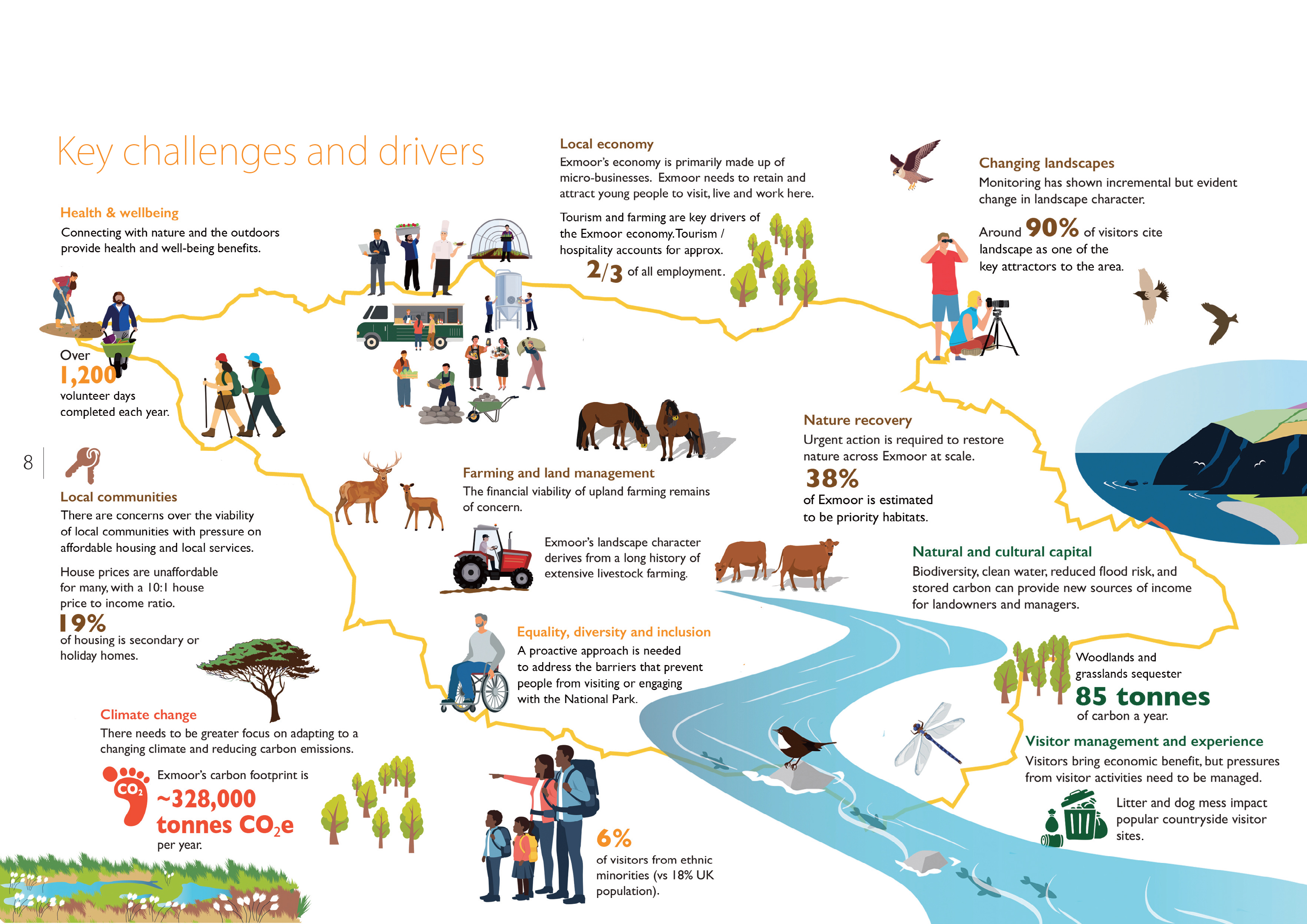

Changing landscapes: The challenges and opportunities facing Exmoor
There are many forces for change affecting Exmoor’s landscapes, some of them global, others very localised in effect. While we do not have control over all these impacts we need to understand and be aware of them, so that we can respond and adapt to ensure Exmoor is resilient and thriving now and in the future. Details of the trends and changes affecting Exmoor’s special qualities are set out in the State of the Park Report[1] that accompanies this Partnership Plan and the Landscape Character Assessment[2].
A summary is given below
Climate change: The impacts of climate change are evident now and will impact all aspects of the National Park so there needs to be greater focus on adapting to a changing climate and increasing resilience. Exmoor also needs to play its part in the global drive to reduce carbon emissions.
Nature recovery: Urgent action is required to restore nature across Exmoor at scale. Statutory Local Nature Recovery Strategies are being prepared and will feed into the Plan along with targets from Exmoor’s Nature Recovery Vision and those cascaded down from the Government’s Environmental Improvement Plan.
Farming and land management: The transition to the environmental land management scheme is ongoing but still holds much uncertainty over the details of how this will be implemented and the funding that will be available. The financial viability of upland farming remains of concern.
Changing landscapes: The National Park designation means that Exmoor has not seen the same level of development as in other areas, but it is not immune to other changes arising from climate change and changing land management. Landscape monitoring has shown incremental but evident change in the nature of the land cover and vegetation and the occurrence of man-made features such as telecommunications masts. There will also be changes in landscape character as a result of nature recovery ambitions and the response to climate change.
Local communities: There are ongoing concerns over the viability of local communities with pressures on affordable housing and local services and high levels of second homes / holiday lets. The need for significant numbers of additional homes nationally may bring pressure for development close to or in the setting of the National Park. An ageing population brings challenges in terms of service delivery, but also opportunities from the positive contribution older people can make to local communities.
Local economy: Exmoor’s economy is primarily made up of micro-businesses. Tourism is the largest sector in terms of employment and number of businesses, Farming and land management are also important to the local economy and part of Exmoor’s cultural heritage. New technologies are changing the way markets and sectors work, and digital connectivity is more important than ever. The need to change, adapt and learn new skills will be essential for business and economic growth. Exmoor needs to retain and attract young people to visit, live and work here.
Natural and cultural capital: The next few years are likely to see a growing trade in natural capital assets such as biodiversity, clean water, reduced flood risk, and stored carbon. These potentially provide new sources of income for landowners and managers on Exmoor who can provide a supply of these assets but there is uncertainty over the long-term value and credibility of some of these schemes.
Finance and delivery: Action to address these strategic challenges will require resources and partnership working at a time of severe budgetary challenges. New sources of investment and funding will need to be found, including from the private sector.
Policy: With a change of Government in July 2024, there changes in Government policy for the environment, farming and planning, which will all influence priorities for the National Park and how these can be delivered.
Visitor management and experience: Visitors bring economic benefit, and National Parks are designated to give people the opportunity to understand and enjoy these special places. But pressures from visitor activities need to be managed. The number of visitors to Exmoor is relatively stable, and the Plan does not anticipate a significant increase in visitors over it’s five year period, but a growing population and increased house building around the National Park may increase day visits in the longer term. Travel to and around the National Park has a high carbon footprint, so developing sustainable transport, and access and recreation opportunities will be essential for the health and wellbeing of our residents and visitors, as well as helping to reduce carbon and support a better visitor experience.
Health & wellbeing: The long-term impacts of the covid pandemic are still being felt, and have had a significant impact on people's physical and mental well-being, on top of more general and long-standing health and wellbeing challenges. Rural communities and particularly farming communities feel the impact of loneliness and isolation. The health and well-being benefits of connecting with nature and the outdoors are now widely recognised and provide an opportunity for increased engagement with the National Park. But the people that may benefit the most from better connection to Exmoor are often those that find in hardest to do so.
Equality, Diversity and Inclusion: Inequality in the UK is at the highest level for over 50 years and within and around Exmoor there are many pockets of rural poverty and areas of very high deprivation. Many people face barriers that prevent them from visiting or engaging with the National Park and a proactive approach is needed to reach out to them and work with people within those communities to provide greater opportunities and awareness.